Even now, says the Lord, return to me with your whole heart, with fasting, and weeping, and mourning. Rend your hearts, not your garments, and return to the Lord, your God, for he is gracious and merciful, slow to anger, abounding in steadfast love, and relenting in punishment. –JOEL
In a sobering but typically pastoral manner, Saint Benedict tells us in his Rule that the “life of a monk ought to be a continuous Lent.” Then he adds, “since few have the strength for this, we urge the entire community during these days of Lent to keep its manner of life most pure and to wash away in this holy season the negligences of other times.” Lent is then a time for monastic renewal and added vigilance.
Father Michael Casey reminds us that the renunciation Benedict is advocating is in fact a Gospel “imperative which is an attempt to eliminate anything that could obstruct, distract from or substitute for the love of Christ.” Indeed, all of our attempts at Lenten observance whether fasting, almsgiving or efforts to make more time for prayer are valid, useful and truly Gospel-driven only if they lead to greater love for Christ and for all the members of his Body.
Lent means springtime, a time for new growth, growth in loving. It is never, ever about spiritual athleticism or just toughing it out until a great splurge at Easter. It is all about making room for love, compassion and mercy. We give up other bodily “delights,” so that we can be more available to “delight” in loving Christ Jesus our Lord and all of our sisters and brothers in Him. Love is the only reason.
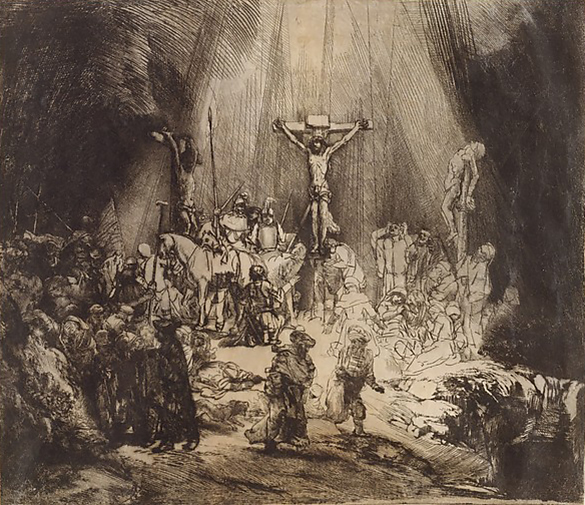
Christ Crucified between the Two Thieves: The Three Crosses, Rembrandt van Rijn, (Dutch, Leiden 1606–1669 Amsterdam), 1653, Drypoint printed on vellum, Plate: 15 x 17 1/4 in., The Metropolitan Museum of Art. Used with permission.
Christ Bearing the Cross, North Netherlandish (Utrecht?) Painter (ca. 1470), Oil on wood, 42 3/8 x 32 3/8 in., The Metropolitan Museum of Art. Used with permission.